Not everyone in the United States, or around the world, views Donald Trump favorably. Throughout his political career, the former president has been a deeply divisive figure, admired passionately by supporters and criticized sharply by opponents for his blunt language, unconventional behavior, and frequent controversies. This polarization was once again on display during a recent visit to a Ford manufacturing plant in Dearborn, Michigan, where a confrontation with a heckler quickly became a national talking point.
The incident unfolded at Ford’s historic River Rouge complex, a landmark of American industrial power that has employed generations of workers and symbolizes the country’s manufacturing legacy. Trump arrived at the facility wearing a black peacoat, moving through the factory floor to address employees. His visit was intended to spotlight domestic manufacturing and emphasize policies he claimed strengthened American industry during his time in office. What was expected to be a standard appearance, however, took a dramatic turn.
Trump, donning a black peacoat, made his way through the factory floor to address employees, intending to highlight the accomplishments of American industry under his administration, and to promote policies designed to strengthen domestic manufacturing.
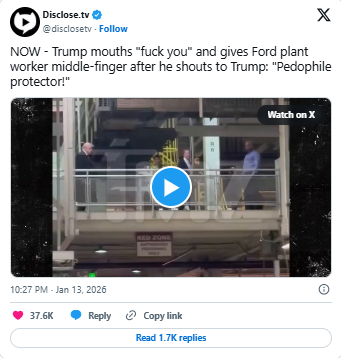
According to reports, a worker in the crowd shouted a highly provocative accusation, calling Trump a “pedophile protector,” a phrase widely understood as referencing his past association with Jeffrey Epstein and the controversy surrounding unreleased Justice Department files. Video footage captured Trump’s reaction as his demeanor shifted sharply. Witnesses said he pointed toward the heckler, mouthed an explicit insult, and appeared to tell the individual “you’re fired,” echoing his television persona, before making an obscene hand gesture as he walked away.
The exchange spread rapidly across social media and news outlets, igniting intense debate. Supporters defended Trump, arguing that he was responding to extreme provocation and behaving consistently with his straightforward style. Critics countered that such conduct was inappropriate for a public figure and undermined standards of civility. The White House responded swiftly, with spokesperson Steven Cheung describing Trump’s actions as justified and controlled under the circumstances, while Ford emphasized its commitment to maintaining professionalism within its facilities.
The confrontation occurred amid renewed scrutiny of Trump’s ties to Epstein and delays in releasing related federal documents. Lawmakers from both parties have pushed for greater transparency, while officials cite legal and ethical concerns. Analysts noted that the Dearborn incident encapsulated Trump’s political persona: confrontational, emotionally reactive, and polarizing. For supporters, it reinforced authenticity; for critics, it raised further doubts about his temperament. In a climate of heightened political division, the moment became a vivid example of how leadership, accountability, and public conduct are debated in modern America.